22/22
Challenger Brands:
Out With The Old…
New world economy brands have created a paradigm shift—disrupting categories with new pricing and distribution models, customer experiences, and rapid product innovation cycles.

The traditional Challenger Marketing Playbook has been upended. Dramatically.
The days of the heavy comm-led Challenger efforts by Burger King, Pepsi, and Avis are not so much gone as outdated and ineffective. AI, social media, digital, and influencer marketing have laid waste to traditional best practices. Traditional Challenger brands now have to relook at their playbooks.
But even new world economy companies, for all their disruption and innovations, falter. As predominantly product-led companies, they often struggle with long-term business growth because they haven’t simultaneously focused on creating a disruptive brand to foster that consumer ‘stickiness’ needed to withstand the long-term competitive pressures.
These modern times call for a modern Challenger Playbook, and we organized our approach along three buckets:
- Out Think the category
- Out Innovate the competition
- Out Connect with the audience
These principles build on existing Challenger Playbook foundations–and classic challenger brands like Apple and Virgin Atlantic–but critically incorporate lessons from new world economy challenger titans like Netflix and Airbnb, and also newbies such as Glossier, Fenty, Warby Parker, and Casper. The final ingredient is our own in-the-trenches experience with challenger companies like Vrbo (travel), e.l.f. (cosmetics), and Eargo (hearing). The following principles are not just academic theory (my pet peeve with most of the books written on branding) but also vetted by our own invaluable on-the-job learning as clients, agency alumni, and marketing consultants.
Principle #1: Out Think The Category
You’ve got established category leaders ahead of you. How do you even get yourself noticed and stand apart as the choice when you’re #2, #5, or no number at all (as yet!)?
Define the fight you’re in:
Your ambitions are bigger than your resources, so prioritizing mindset over market share is key–bold, disruptive thinking and possessing an agility that your bigger competitors with their bureaucratic, matrixed organizations simply don’t have. Challengers act, fail, learn, and act. They see every obstacle as a creative opportunity. The trick is to define the fight you’re in and to do so in the biggest and most commercially fertile available terms right out the gate.
Identify the enemy and base your stated mission on that foundation. That ‘why’, that purpose, is crucial to Millennial and Gen Z appeal today for any brand, but especially if you’re operating as a Challenger.
- Apple did it by pivoting off the complexity of the entire tech category to offer simple, intuitive solutions across all products, services, and channels. At Samsung, we pivoted off of Apple’s Closed ecosystem to champion Open as not just an operating platform but a mindset that infused all our innovations.
- Glossier Beauty pivoted off of the cosmetic category’s traditional ‘beauty dictated from the top down approach’ to democratize beauty through peer-to-peer inclusion.
Identify the customer pain points as related to the point above and a quick hack: Check out the existing category or competitive behavior and identify the tension point(s) that are unresolved for the consumer, and then bring something to the world no one else does.
- Eargo created hearing aids that were virtually invisible. The enemy: Visibility–and not just with the honking big over-the-ear devices that have stigmatized the category, but also in identifying every pain point of the purchase and trial process that hindered the customer's purchase and emotional acceptance.
Identify a differentiated business model in order to understand which channel to best outsmart the competition.
- Dollar Shave Club took on Gillette’s pricey shaving blades via a DTC/subscription pricing model that stopped Gillette in its tracks. Caspar, Eargo, and AllBirds all did the same within their respective categories.
- Netflix destroyed Blockbuster video rentals and television in general with DVDs and then on-demand streaming.
- Airbnb introduced peer-to-peer lodging vs the hotel industry.
- Uber took on traditional taxi services with an on-demand app.
Identify the category you really play in in order to reframe the competitive set and pave the way for long-term growth. How broadly you define the business you’re really in matters a lot for immediate and long-term growth:
- Caspar defined itself as a sleep wellness company, not as a mattress company, and extended their business to complementary items like sheets, blankets, etc., and even dog mattresses. Woof indeed.
- Tesla, before Elon Musk went from genius to evil genius, saw itself as being in the sustainable energy business. Electric vehicles were one offering, but so were solar panels, motorbikes, semi-trucks, etc.
Principle #2: Out Innovate The Competition
The old Challenger Playbooks may not go here, but you’re going to have to–whether you want to or not!
Lead with a rapid Innovation cycle:
What defines not just tech companies' mindsets today (Google and Samsung are proud beta-culture companies), but also many new world economy brands’ mindsets, is their rapid innovation cycle. e.l.f. takes 20–27 weeks from concept to product introduction. Glossier’s is a 4–12-week product cycle. Ditto Fenty. At Samsung, I got dizzy from being in a perpetual 365/24/7 product launch cycle (but then Lee would say I’m dizzy regardless of a manic workplace).
How do they do this?
Turn Data into Product Development: A lot of new world challenger brands lean heavily into their social and digital channel data to listen to customer input, complaints, and feedback—and then use that insight to iterate, brief, and focus group test the resulting product development with their communities first, before going wide. AI-powered data is increasingly being used to track changing consumer attitudes, trends, identify gaps, and solicit user feedback to directly input into product development and R&D, which keeps companies competitive.
- Netflix pioneered using social listening and data in 2011 to greenlight programming based on tracking consumer sentiment, memes, and conversations (solving the mystery of how we got Bridgerton Season 4 inflicted on us).
- Glossier built its product line directly from customer conversations on Instagram and Reddit, as well as direct briefs from the company to its consumers to create a built-in market for products like Boy Brow. Ditto Fenty and e.l.f. (Steve Jobs, with his inside-out, top-down innovation approach, would be turning in his grave).
Ideally, combine two different elements to build a unique category of one:
- Netflix combined video rental + streaming.
- Uber combined taxi service + mobile/digital app.
- Airbnb combined lodging and peer-to-peer marketing.
- Samsung combined the phone and tablet to create the new Fold category.
… or borrow from another category's rules: This is not done enough by anyone, but it is a quick hack to differentiation and growth.
- Apple famously borrowed from the Four Seasons and The Ritz-Carlton concierge service to create the Genius Bar service, and then was inspired by local town square gatherings to create similar community “stickiness” in its flagship stores.
- At Eargo, we borrowed from Apple to create a complete user journey based on hearing wellness.
Principle #3: Out Connect With Your Consumer
The key difference between successful Challenger and Mainstream brands:
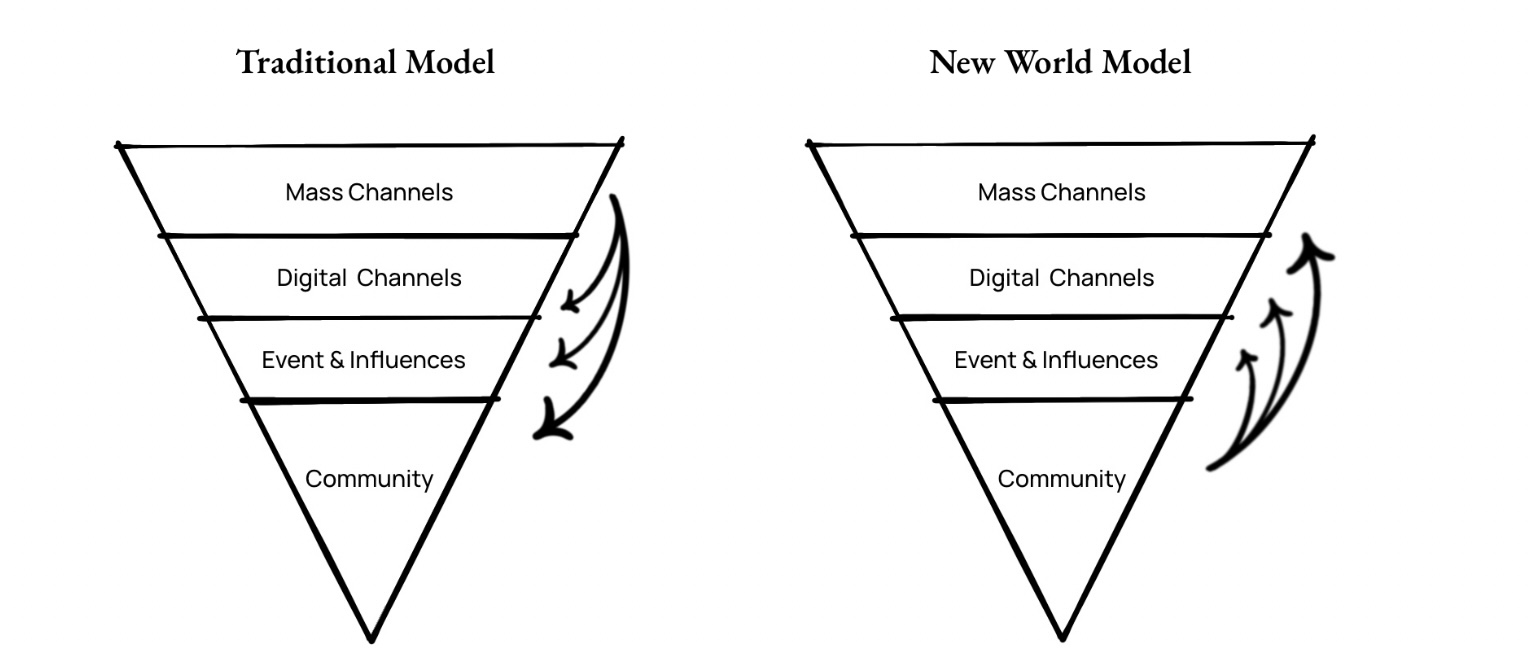
- Traditional brands work the marketing top-down–they bring their product to the consumer.
- Successful new world economy challenger brands build their funnel bottom up with organic growth driven by building community and word of mouth. They ‘over connect’ with a small group of passionate fans who then evangelize the product upwards. They bring the consumer to the product.
- The crucial factor here is it’s the company, not the consumer, who controls the ‘brief’ and the narrative, i.e., “We created this category, built this product, etc., because of this massive consumer issue. We think the ideal product should adhere to these criteria. What would you add or change?” The company still sets the strategy.
Some key best practices:
Focus on Owned and Shared channels vs Paid, to inspire and own the customer experience: Traditional category leaders tend to focus heavily on their vertical marketing efforts and often ignore all the company’s horizontal touchpoints outside of marketing that can effectively communicate the brand.
Challenger brands, by contrast, know they don’t have the budgets to own all elements of the customer journey–pre-purchase, purchase, and post-purchase–so instead wisely focus on places where category leaders traditionally aren’t as skilled, dominant, or advantaged to build their competitive edge.
They may only focus on Events, PR, and their social channels during pre-Purchase. Dotcom/e-Comm and AI chatbots for Purchase or customer service, and service/return warranties for post-Purchase. All owned.
- Fenty Beauty has taken events, PR, and influencer marketing to a whole other level. Fashion show/product launch events invite all the beauty press and editors, local/global influencers, and superfans (given generous sample kits so they can try them before their followers) to kick off the WOM and sales. E-comm and retail are the beneficiaries. Paid marketing is mostly limited to search re-targeting.
- Disruptive packaging can be a massive brand builder. Glossier did it with its “shelfie-ready”, Insta-friendly pink bubble wrap pouch that made unpacking the product an event that women filmed and posted on their socials. Packaging became viral.
This can be even more powerful because it is based on what a brand does (horizontal marketing) as well as what a brand says (vertical marketing). This is what creates brand stickiness, love and word of mouth with Gen Z today.
Build content with the right tone of voice that adds value to the community and deepens fandom: Glossier, e.l.f., and Fenty all do this via beauty blogs, advice tutorials, hosting virtual makeovers, “chat now” features with beauty advisers, skin-customized beauty content, and rewards/loyalty programs that create superfans and turn them into ambassadors.
Again, these are all on ‘brief’ and further the brand narrative. The resulting user-generated content tends to mimic that company-established narrative and validates and authenticates the company’s products and posts.
A bold, creative, rebel-like tone that immediately sets you apart from the typically staid competition is a must here. Virgin Airlines took the piss out of British Airways’ matronly image to become the rock ‘n roll way to travel. And e.l.f. uses Jennifer Coolidge and Melissa McCarthy to inject campy humor to distinguish itself in a very earnest beauty category.
Identify the fault lines in your competitor’s marketing:
- Pepsi did the ultimate challenger marketing back in the ‘80s by positioning itself as the hip, youthful alternative with ‘Choice of a New Generation’ and repositioning Coke Classic (emblazoned right under the logo on every package) as the older, unhip choice. Coke didn’t remove the word Classic from its label until the late 2000s, nearly 20 years after the initial Pepsi Challenge.
- MINI Cooper identified the competitive fault lines in their media approach. On a reportedly $20MM budget, they took on SUV size (the enemy) and the Big 5 Automakers and focused their media efforts in regions where car culture communities were dominant and, within those regions, laser-focused their media on breakthrough targeted print and out-of-home.
- Apple’s renaissance followed the same playbook: a regional play where creative communities reigned and then dominated the media with print and OOH. Success followed for both.
It’s not always about money, but it is about discipline and focus.
Wrapping It All Up
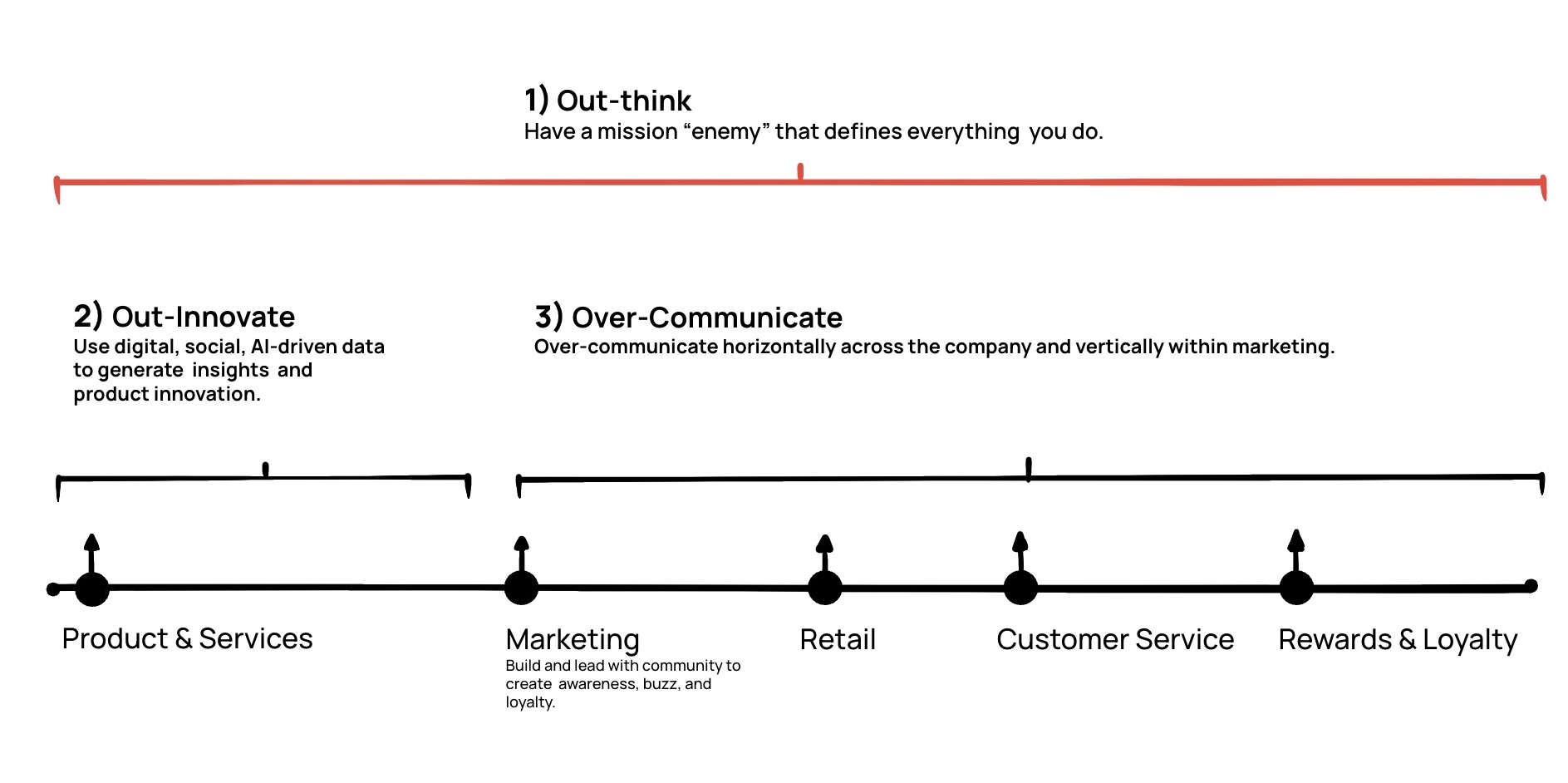
Three key actions:
- Start with a clear mission, your “Why,” and anchor all efforts based on that. Make sure you’ve studied the category, competition, and channels to figure out where you can best disrupt on unmet customer needs, product, new channels, pricing, etc.
- Agility is everything. Close the gap between customer input and output (product, market, or other) to innovate. Disruptors are bold and quick, and they iterate their way to success.
- Focus not just on the traditional Vertical Marketing channels, but also on how the Horizontal and Owned or Shared functions can help build your brand.
But one key takeaway we’d love to leave you with: you don’t have to be a Challenger brand to apply a lot of the above. After all, which one of us today doesn't work for companies facing challenging times?
Sources:
eatbigfish - "The Challenger Project"
The New Yorker - "How Glossier Made Effortlessness A Billion Dollar Brand"
Lantana - "How Fenty Beauty Built Brand Awareness — and Won"
Book by Adam Morgan - Eating the Big Fish: How Challenger Brands Can Compete Against Brand Leaders
